
 ChatGPT
 Perplexity
 Claude
A black ant walks across your counter and one question follows it: harmless visitor, or a threat to the house? The reflex is to go by colour, and that is exactly the trap. In Quebec, the carpenter ant is very often black too. The real difference between the two shows up somewhere else: size, behaviour and, above all, the evidence they leave behind. A black field ant is a nuisance. A carpenter ant tunnels galleries through the wood of your structure. Here is how to identify them without getting it wrong, with a comparison table and a quick test to back it up.
Carpenter ant vs black ant: the comparison table
| Criterion | Carpenter ant | Black ant (field ant) |
| Worker size | 6 to 13 mm (queens up to 25 mm) | 3 to 5 mm |
| Colour | Black, brownish, or black and reddish | Uniformly black |
| Thorax | Arched and even, rounded profile | Irregular, slender body |
| Mandibles | Powerful, built for gnawing wood | Poorly developed |
| Speed | Rather slow moving | Moves very fast |
| Activity | Mainly nocturnal | Mainly diurnal |
| Nest location | Damp wood: walls, beams, stumps | Soil: lawn, sidewalk cracks |
| Signs left behind | Fine sawdust near the wood | Mounds of soil in the lawn |
| Risk to the house | Real structural damage | No structural damage |
The quick 3-question test
No time to study a thorax? These three questions settle most cases:
Is the ant bigger than 6 mm? An ant clearly larger than average, especially past 1 cm, points to a carpenter ant. A small, fast ant of 3 to 5 mm is almost always a black field ant or a pavement ant.
Do you find sawdust or mounds of soil? Fine sawdust under a baseboard, a window frame or in the basement gives away galleries cut into the wood. Mounds of soil in the lawn point to a black ant nest, harmless to the structure.
Do you see them at night, or in winter? Carpenter ants come out mostly after dark, and ants active inside the house in January are a near-certain sign of a carpenter ant nest in the building.
Two answers out of three pointing at the carpenter ant? Time to take the situation seriously.
The carpenter ant: the threat to your structure
What it looks like
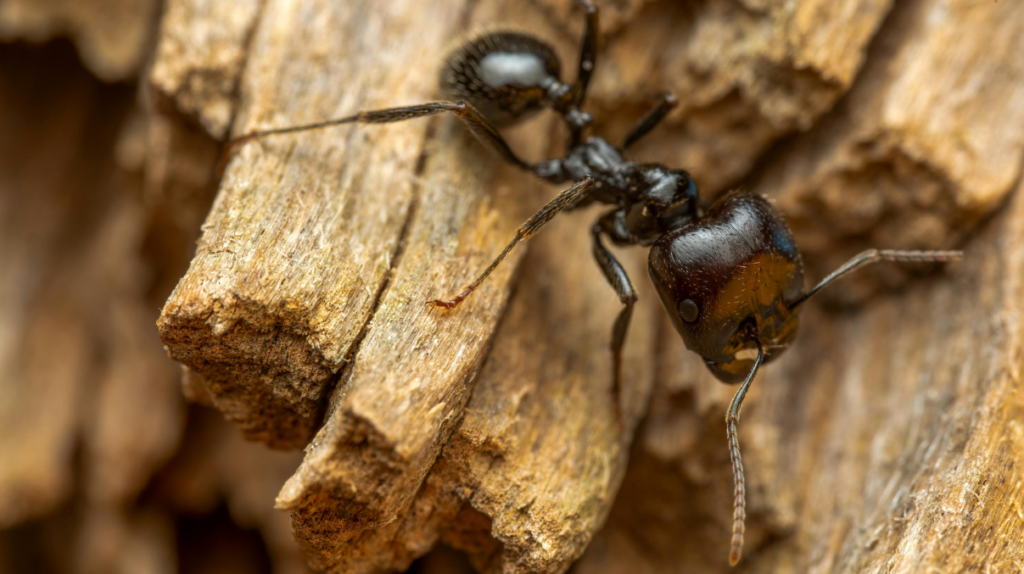
The carpenter ant (genus Camponotus) is the largest ant in Quebec: workers measure 6 to 13 mm and queens can reach 25 mm. Its colour runs from black to reddish brown, sometimes within a single colony, which is exactly where the confusion with the black ant comes from. Its antennae are elbowed, its thorax is arched and evenly rounded, and its powerful mandibles let it gnaw through wood. In the spring, the reproductives carry wings.
One important point: it does not eat wood. It excavates it to build its nest and pushes the shavings out, which produces that telltale fine sawdust, what the trade calls frass. A mature colony has a parent nest, often in a stump or in decaying wood outdoors, and satellite nests inside the house, tucked into the damp wood of walls, beams or the attic. Moisture is the magnet: a water leak, a plumbing failure or a poorly ventilated room creates perfect conditions.
The signs that should put you on alert
Small piles of fine sawdust near baseboards, window frames or in the basement;
Winged ants (swarmers, or alates) appearing indoors in the spring, the sign of an established colony;
Large ants active at night, especially in the kitchen and the bathroom;
Ants visible in the middle of winter, a near-certain clue of an indoor nest;
A faint rustling inside the walls, audible at night;
Wood that sounds hollow around damp areas.
Seeing a single large ant in the spring is not an infestation, but repeated sightings deserve a professional inspection.
The black field ant: a nuisance with no structural danger
What it looks like
The black field ant (Formica subsericea and related species) measures 3 to 5 mm, with a slim, slender, uniformly black body that sometimes shows a silvery sheen. It moves very fast, in long, well organized trails guided by pheromone paths, and it is mostly active during the day. Unlike the carpenter ant, it never tunnels into wood. In Quebec, the name black ant usually covers three insects: this black field ant, the pavement ant (Tetramorium immigrans) of driveways and patios, and the little black ant (Monomorium minimum). None of them destroys wood.
Where it settles
Its nest sits in the soil: lawn, garden, sidewalk cracks, under stones and patio slabs. The small mounds of soil in the grass are its signature. It comes into the house only to feed, drawn by sweet food, grease and crumbs in the kitchen or the pantry. It is also fond of aphid honeydew, which it goes as far as farming on garden plants. Annoying? Yes. Dangerous to the structure? No. The same logic applies to the pavement ant, its cousin from patios and garage entrances.
Need a carpenter ant identified? Our experts settle it
Send us a photo or book an inspection: more than 25 certified technicians identify the species and give you a straight answer, with a fixed price before any work.
Why getting the two mixed up costs money
Confusing the two species leads straight to the wrong treatment. Treating carpenter ants like ordinary black ants, with a hardware store aerosol, kills a few workers and scatters the colony without ever reaching the queen. Meanwhile, the galleries keep spreading through the beams and the joists. The reverse costs money too: panicking over harmless field ants can have you paying for a treatment you never needed.
The stakes are real. A carpenter ant colony that has been settled in for years weakens the framing and leads to expensive repairs. In Quebec, it is also one of the few insects that can be treated as a latent defect (vice caché) when a property is sold.
That is exactly why the Pestora method includes a formal identification step before any treatment. Our technicians, certified by the ministère de l’Environnement du Québec (MELCCFP), confirm the species involved and then adapt the strategy: a serious insect exterminator never treats blind. Our divisions cover the whole territory, from the exterminator in the West Island, where wooded sectors are full of carpenter ants, to the exterminator in Lanaudière, with 24/7 service and unmarked vehicles.
The right diagnosis is worth more than the best insecticide.
What to do based on the species you identified
If it is a carpenter ant
Act quickly, because the colony grows with every season. Locate the active zones (sawdust, night time comings and goings), fix the moisture problems, and stay away from aerosols that scatter the nest. Baits that workers carry back to the queen remain the only approach that works long term, and our guide on how to get rid of carpenter ants walks through every step. For guaranteed elimination, our carpenter ant extermination service includes the inspection, treatment with Health Canada approved products, follow-up and a written guarantee.
If it is a black ant or a pavement ant
No need to panic: put your effort into prevention. Seal up cracks and entry points, store food in airtight containers, wipe down surfaces and keep the lawn thick and healthy. If ant trails keep coming back in the kitchen anyway, the reason is usually the same: the nest is outside, the food is inside, and the pheromone trail rebuilds itself. A perimeter treatment by a residential exterminator settles that, and our exterminator in Greater Montreal handles those repeat summer calls across the island. For properties overrun every year, an integrated pest management program stops colonies from settling in before they get established.
Carpenter ant extermination: guaranteed in writing
Inspection, identification, treatment and follow-up: the Pestora method eliminates the colony at the source, at a fixed price.
FAQ: carpenter ant or black ant?
Is a large black ant always a carpenter ant?
Almost always, yes. In Quebec, a black ant longer than 6 mm seen inside the house is very likely a carpenter ant, especially if you spot it in the evening. The black field ant, much smaller and much faster, rarely exceeds 5 mm.
Can black ants damage my house?
No, not the structure. They do not tunnel into wood: they nest in the soil and come inside only to find food. Their impact stops at food contamination and the nuisance of trails across the kitchen. The real structural risk belongs to carpenter ants.
How do I tell a carpenter ant from a termite?
The ant has a narrow, pinched waist (the petiole) and elbowed antennae. The termite has a body with no marked waist and straight antennae. Another marker: the carpenter ant pushes out sawdust, while the termite eats the wood and leaves no shavings behind. The good news is that termites remain extremely rare in Quebec.
Why am I seeing winged ants in the spring?
Those are the reproductives leaving the colony for the nuptial flight. Winged ants outdoors are nothing to worry about, but their appearance inside the house means a carpenter ant colony is established in the building. That is a signal to inspect immediately.
Do carpenter ants sting?
They do not sting, but they can bite with their mandibles and release formic acid, which causes a stinging sensation. Nothing dangerous for people or for pets: the risk from this species is structural, not a health risk.
What if I cannot identify the species?
Take a sharp photo next to a reference object (a coin works well) and note where and when you see the ants. Our experts identify the species and assess the situation free of charge, and the Pestora blog gathers our identification guides for Quebec pests.