 ChatGPT
 Perplexity
 Claude
A large black ant strolling across the kitchen counter in spring is not always harmless. In Quebec, the carpenter ant is the insect that does the most damage to homes: it hollows out galleries in structural wood to house its colony. Unlike an infestation of common black ants, the problem does not go away with a hardware store trap. To get rid of carpenter ants for good, you have to understand how they live, find their nests and target the queen. Here is the process, step by step.
How to identify carpenter ants
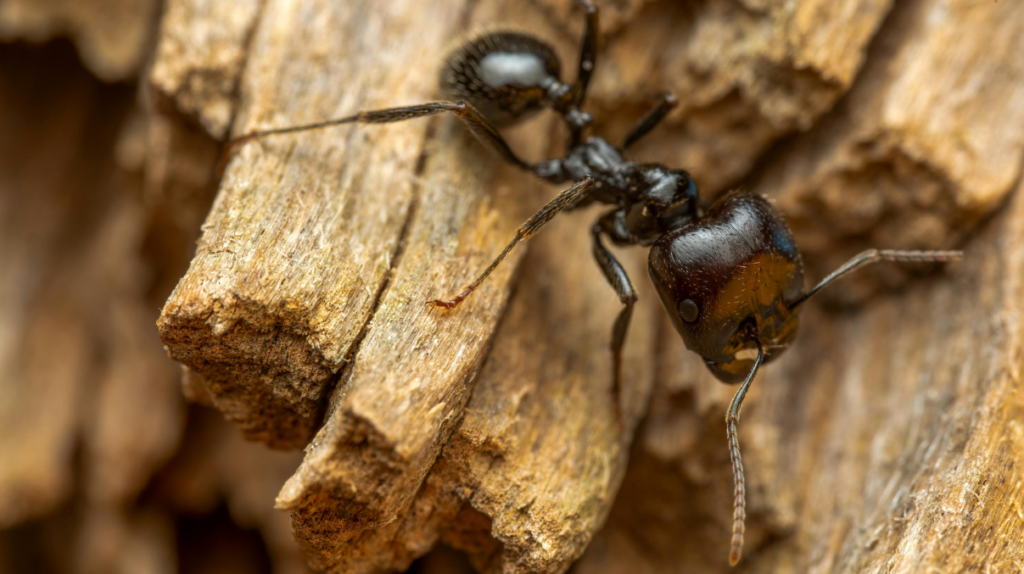
Before you treat anything, you need to be sure you have the right insect. Carpenter ants are the largest ants in Quebec: workers measure 6 to 13 mm, and a queen can pass 20 mm. Their colour runs from black to reddish brown, and their powerful mandibles let them chew through wood. In spring, the reproductive ants carry wings, which is why these swarmers, also called alates, are sometimes mistaken for other insects.
Two mix-ups are common:
- With common black ants. These are noticeably smaller and they nest in the ground, not in the structure. They are a nuisance, rarely a threat.
- With termites. Termites have straight antennae and a body with no defined waist, while the carpenter ant has elbowed antennae and a narrow waist. The good news is that termites are very rare in Quebec.
- With pharaoh ants or pavement ants. They take over the kitchen, but they never attack wood.
One more essential distinction: the carpenter ant does not eat wood. It excavates the wood to build its galleries and pushes the shavings out of the nest. If you want to understand why these insects invite themselves in year after year, our pest control blog covers ant behaviour and why colonies keep coming back to the same house.
The signs of a carpenter ant infestation in the house
A colony can work inside your walls for years before anyone finds it. These are the signs to watch for:
- Small piles of sawdust, known in the trade as frass, under baseboards, window frames or in the basement. This is the debris pushed out of the freshly dug galleries.
- Ants active indoors in winter. A carpenter ant spotted in January almost always means a nest inside the building, since outdoor colonies are dormant.
- Rustling in the walls. At night, put your ear against the wall (a drinking glass amplifies the sound). An active colony makes a faint crackling noise.
- Discarded wings near windows after the spring swarming flight.
- Wood that sounds hollow when tapped, especially beams, sills and door frames.
Here is a detail few people know: a mature colony has a parent nest, often outdoors in a stump or a dead tree, plus satellite colonies set up inside the house. That is why squashing the handful of workers you can see does nothing to the infestation. Roughly 95% of the colony never leaves the nest.
Seeing two or three carpenter ants in spring does not mean your house is infested, but repeated sightings deserve a serious inspection.
Why carpenter ants settle in your home
Moisture is the number one factor. Carpenter ants look for damp wood, softened or already attacked by rot, because it is far easier to excavate than sound wood. Water damage, even repaired ten years ago, a roof leak, a poorly ventilated bathroom or overflowing gutters all create ideal conditions.
The entry points are many: cracks in the foundation, cables and pipes running through walls, tree branches touching the roof, firewood stacked against the siding. Once inside, the ants settle into wall voids, attics, insulation, joists and beams, anywhere the structure offers warmth and moisture.
How to get rid of carpenter ants, step by step
1. Locate the parent nest and the satellite colonies
Every extermination strategy starts with a careful inspection. Follow the workers in the evening, when they are most active, look for the piles of frass and tap on any suspect wood. Focus your search around areas that have been wet before: window surrounds, under sinks, the bathroom, the basement, the attic. Do not forget the outside. Stumps, dead trees and woodpiles are where the parent colony usually lives, and a carpenter ant nest outdoors often feeds the one in your walls.
2. Target the queen with bait
Killing the ants you can see with an aerosol insecticide is the most common reflex and the least effective one. As long as the queen keeps laying, the colony rebuilds itself. The proven method is to use bait that the workers carry back to the nest, contaminating their nestmates and the queen. The classic mix combines equal parts boric acid (borax) and icing sugar, placed along the ant trails. A commercial gel bait works on the same principle and is less messy indoors.
This approach takes patience: several weeks can pass before the colony is fully wiped out. And be careful, boric acid is toxic. Keep it out of reach of children and pets.
3. Natural solutions and their limits
Diatomaceous earth, essential oils (peppermint, citronella, lavender) and boiling water poured on an outdoor nest can help in minor cases. Let us be honest, though: these methods repel or kill carpenter ants on the surface, but they almost never reach the queen or the satellite colonies hidden in the structure. Against a colony established in a wall or a beam, they are not enough to kill carpenter ants at the source.
4. Know when to call a professional
Some situations call for a pest management specialist:
- You see carpenter ants indoors in winter.
- You find frass in several places, or you hear noise in the walls.
- Homemade bait has changed nothing after three or four weeks.
- The structural wood looks damaged or sounds hollow.
A certified insect exterminator has access to insecticides approved by Health Canada and to application techniques the general public cannot buy. Above all, never try to open a wall or cut a beam to reach a nest yourself: you risk compromising the integrity of the structure.
A certified carpenter ant exterminator, everywhere in Quebec
More than 25 MELCCFP-certified technicians are available 24/7, with a fixed price and a written guarantee before the work starts.
The Pestora method against carpenter ants
At Pestora, every carpenter ant treatment follows a proven four-step method, applied by every division from the exterminator in Montréal to the exterminator in the Laurentians:
- Inspection: locating the parent nest, the satellite colonies and the moisture sources that drew the colony in.
- Identification: confirming the species, because treating a carpenter ant is not the same as treating a pavement ant.
- Treatment: targeted application of bait and insecticides approved by Health Canada, safe for your family and your pets once dry.
- Follow-up: verifying that the colony is completely gone, plus prevention recommendations, all covered by a written guarantee.
Our technicians drive unmarked vehicles: your neighbours do not need to know you are dealing with an infestation. Our dedicated page on carpenter ant extermination walks through the full service.
How much does carpenter ant treatment cost?
In Quebec, expect roughly $300 to $800 for a standard residential treatment, and more for an advanced infestation reaching several areas of the building, a duplex or a commercial property. The price depends on the size of the colony, how accessible the nests are and the prevention work that needs to follow. Be wary of vague hourly estimates: at Pestora, the quote is free and the price is fixed before any work starts, with no surprise at the end.
Preventing carpenter ants from coming back
Once the colony is gone, a few habits sharply reduce the odds of a repeat:
- Fix every moisture problem: plumbing leaks, the roof, bathroom and crawl space ventilation.
- Replace rotten or damaged wood (beams, sills, balconies) and repaint outdoor wood surfaces.
- Move firewood away from the house and raise it off the ground.
- Cut back branches touching the roof or the walls, and remove stumps and dead trees from the property.
- Seal foundation cracks and do the sealing work around windows, doors and cable entries.
- Store food in airtight containers and clean up crumbs quickly.
For ongoing protection, our integrated pest management program combines preventive inspections with targeted interventions, an approach homeowners who have already lived through an infestation particularly appreciate. Our residential pest control team can also handle the exclusion work on entry points once the treatment is done.
Prevention always costs less than repairing a damaged frame.
Get rid of carpenter ants for good
A thorough inspection, a discreet treatment and a follow-up backed in writing: that is peace of mind, at a fixed price.
Frequently asked questions about carpenter ants
Do carpenter ants eat wood?
No. Unlike termites, they do not feed on wood: they excavate it to build their galleries and push the sawdust out of the nest. They feed instead on insects, honeydew, and the sugary or protein-rich food they find in our kitchens.
Are carpenter ants dangerous to humans?
They do not transmit disease. Their bites can pinch, and that is about it. The real danger is structural: a colony that has been established for years can weaken the beams, the joists and the frames of the house, and lead to expensive repairs.
Why am I seeing carpenter ants in winter?
Outdoor colonies sleep all winter. If ants are moving around your home in December or January, there is an active carpenter ant nest inside the building, kept warm by your heating. It is one of the most reliable signs of infestation: have it inspected without delay.
Do vinegar or essential oils wipe out a colony?
They repel the workers and scramble their pheromone trails, but they reach neither the queen nor the satellite colonies. These natural solutions can support a treatment, never replace one once the colony is established in the structure.
How long does it take to get rid of carpenter ants?
With well-placed bait, expect a few weeks to three months, because the poison has to travel all the way to the queen. Professional carpenter ant control speeds that up with more concentrated products and precise nest location, and the result is covered by a written guarantee.
Should carpenter ants outdoors be eliminated?
Not necessarily. Well away from the house, they play a useful role in the ecosystem by breaking down dead wood. We step in when the colony nests in a tree touching the building, in a stump near the foundation or, obviously, in the structure itself.