
 ChatGPT
 Perplexity
 Claude
A big black ant crossing the kitchen counter one evening in May, then a second one the next morning. Carpenter ants: when to worry, really? The question almost always starts like that. The short answer: one ant on its own proves nothing, but sawdust at the foot of a wall, a rustling inside a wall at night or winged ants indoors in spring all point to a colony already settled in the structure of your house, and at that stage you stop watching and book an inspection.
Between those two situations there is a threshold, and that threshold is what this guide is about: what counts as normal monitoring, what deserves a check on your part, and what justifies calling an exterminator. This guide stops at the diagnosis.
One carpenter ant on its own, should you worry?
No, and that is the first thing to settle. Workers forage far from their nest, sometimes 100 metres from the colony, hunting insects and sweet food, and a suburban house with mature trees around it will see a few pass through every summer without a single nest inside the building. Ants in the flower beds, under a patio slab, in stacked firewood or in an old stump on the lot are no reason to act immediately either: this is not an emergency.
A second point, often missed: Quebec has more than a hundred ant species, and only five belong to the genus Camponotus, the carpenter ants. A big black ant is therefore not automatically a carpenter ant. If the doubt is still about the insect itself, our comparison of carpenter ants and ordinary black ants settles that question before you go any further.
What should put you on alert has less to do with the insect than with the setting around it: how often it turns up, where, in what season, and what it leaves behind.
The six signals that turn monitoring into an alert
Each of these signals points to excavation under way, and therefore to a satellite colony lodged in the wood of your property. Two of them together are usually enough to confirm a carpenter ant infestation, and infestations caught late almost always show several at once.
Sawdust, or frass, at the foot of a wall
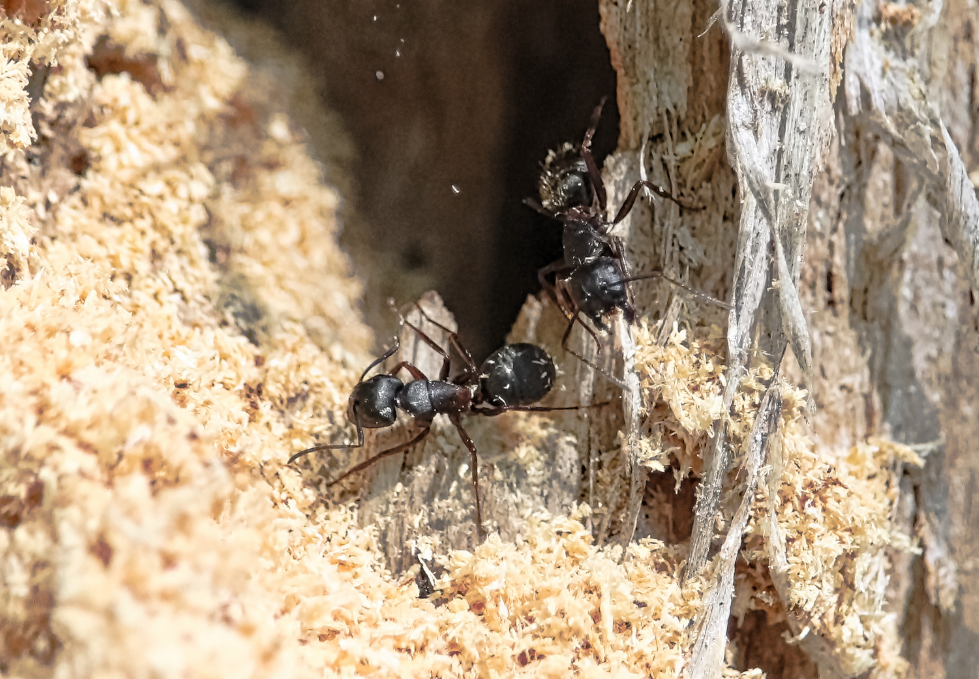
This is the most reliable sign, because it is the direct by-product of galleries being dug. Carpenter ants do not eat wood: they excavate it and push the shavings out through small openings. The pile of fine sawdust looks like pencil shavings, often mixed with bits of insulation, wings and pieces of dead insects. Look for it at the foot of baseboards, under window frames, under basement beams, at the bottom of a door jamb or in a quiet corner of the floor.
The test that settles it: sweep the pile, note the date, come back three days later. If it has re-formed in the same spot, the colony is working in your wood right now. And since termites, which are very rare in Quebec, digest wood instead of pushing it out, fresh frass almost always means a carpenter ant or another wood-boring insect.
A rustling in the walls at night
A colony settled inside a wall makes a dry, irregular crackling, close to the sound of tissue paper being crumpled, produced by mandibles chewing wood and by workers moving through the galleries. It is easiest to hear at night in a quiet house, sometimes under a floor or in a ceiling as well. Health Canada suggests pressing an upturned glass or a stethoscope against the wall to pick it up. Not everyone hears it, but those who do can place the nest within a few dozen centimetres.
Winged ants indoors in spring
This is the signal that carries the most weight. A carpenter ant colony produces winged reproductives only once it is mature, after three to six years and roughly 2,000 workers. Winged ants coming out of wall cracks, a recessed light fixture or a window frame between April and June are not arriving from outside: they come from a nest already established inside the structure. A swarm seen outdoors above a stump, on the other hand, is a normal spring event.
Wood that sounds hollow
Take the handle of a screwdriver and tap the wood in the areas you suspect: door sills, the bottom of window frames, the rim joist around the basement, a beam above an old water leak. A dull, hollow sound, or a screwdriver that sinks in without resistance, gives away the galleries. Excavated galleries are smooth, clean and parallel to the wood grain, with no mud and no debris. That is the carpenter ant signature, and it is structural damage that keeps progressing without changing the look of the surface.
Regular night activity, always on the same route
These ants are mostly active after dark. At dusk they move in single file along baseboards, pipes or a beam, and they take the same route one evening after another. A steady line that disappears into a crack in a wall gives you the direction of the nest, and two or three sightings in the same place are worth treating as a signal.
Ants indoors in the middle of winter
Dormant through the cold season, carpenter ants should not be moving around a home in January. If you see them, the colony is lodged in a heated part of the building and the warmth is keeping it active. This signal needs no confirmation.
What to do based on what you are seeing
| What you are seeing | What it indicates | What to do |
| One or two ants now and then in summer | Occasional presence, no nest in the building | Watch, note the place and the date |
| Ants every day in the same spot | Nest nearby, outdoors or in the structure | Inspect the closest damp area |
| Sawdust, rustling, wood that sounds hollow | Active nest in the wood of the house | Have a professional inspect |
| Winged ants indoors, or ants in winter | Mature colony settled in the structure | Call without waiting for the season to end |
Why moisture changes everything in the diagnosis
A colony does not settle into just any wood. Almost every home in Quebec is wood-framed, which puts moisture at the centre of the diagnosis. Carpenter ants look for damp, damaged or decaying wood, softer and therefore easier to excavate: the softwoods used in Quebec framing suit them well, and so do sprayed urethane and extruded polystyrene, which workers hollow out just as readily. Glued products, plywood and engineered wood interest them far less.
That gives you a search method instead of a random inspection. Start wherever water has been, looking for traces of an old water leak: a window that has leaked before, the surround of a bathtub or a shower, the rim joist behind an overflowing gutter, the basement ceiling under a bathroom, the base of a chimney, a shared garage wall. In almost every case, the infestation and a moisture problem sit in the same place, and the second one causes the first. The parent nest itself is almost always outdoors, in dead or rotten wood: a stump, logs lying on the ground, a fence or a deck in contact with the soil, sometimes even on a neighbour’s lot.
That is also what explains recurrence: as long as the wood stays damp, a new colony will find the site attractive. It is the reason prevention on our carpenter ant page starts with the wood and the water rather than with the ants.
What structural damage is really at stake
Let us be accurate without being alarmist. A carpenter ant colony will not bring a house down in one season, and the pace has nothing in common with termites. The problem lies elsewhere: the work is invisible, it carries on for years, and the damage never repairs itself.
Galleries hollow out structural wood from the inside, which reduces its load-bearing capacity and eventually weakens the member without any change in the look of the surface. By year three, the colony already numbers around two thousand workers and begins budding off into satellite colonies, each one digging in turn. The pieces under the most load are the ones that give way first: sills, window frames, the rim joist, porch beams, a section of framing above a leak.
For a homeowner, two financial consequences are worth spelling out. First, repairing a joist or a window frame routinely costs several times the price of a treatment. Second, in Quebec, a known and undisclosed carpenter ant infestation can be treated as a latent defect when a property is sold: property value suffers, and a pre-purchase inspector knows exactly where to look for frass. A colony never leaves a house on its own. It expands.
Not sure what you are looking at in your own home?
A certified technician locates the parent nest and the satellite colonies, confirms the real extent of the infestation and gives you a free quote, fixed price before work.
When you stop watching and pick up the phone
The rule is easy to remember. A single mild signal, a few ants seen now and then, is worth watching for a week or two. Two signals together, or either one of the two serious signals, frass and winged ants indoors, justifies a professional inspection right away. The same goes if you are selling or buying a property, or if you have confirmed a moisture problem in an area where ants are moving.
Two things to avoid while you wait for the visit. Do not spray hardware-store repellent insecticides along the trails: those surface treatments and over-the-counter products kill a few workers, drive the colony to scatter into new satellite colonies and erase the very clues a technician needs to locate the nest. Do not plug the opening the sawdust is coming from either; keep a sample of the pile instead. If you want to know what actually works and what does not, our guide on how to get rid of carpenter ants sorts it out, boric acid baits included.
A serious inspection does not stop at confirming the species. A specialist probes the wood in the areas at risk, measures moisture, follows the trails back to the entry points, foundation cracks, failed caulking and tree branches touching the roof, then separates the parent nest, almost always outdoors, from the satellite colonies lodged in the structure. That distinction is what decides the treatment plan, because eliminating a satellite colony without reaching the queen settles nothing: our specialists work with baits and non-repellent insecticides that the workers carry back to the queen themselves. The full method is set out on our carpenter ant extermination page.
At Pestora, the free assessment commits you to nothing, the price is fixed and given before the work starts, and the treatment is covered by a written guarantee handed to you before the work begins, with return visits included. Our teams handle residential extermination across Quebec, from Greater Montreal to the Laurentians and Gatineau in the Outaouais. For an apartment building or a commercial property, an integrated pest management program adds scheduled inspections and a preventive component, which is still the best protection against a colony settling in quietly.
Frequently asked questions about carpenter ants
Does one carpenter ant mean my house is infested?
No. A lone worker can come from an outdoor nest dozens of metres away and step inside only to look for food. It is the repetition in the same place, day after day, that should send you to inspect the area. One ant seen once in July calls for nothing more than a little attention.
How do I tell carpenter ant sawdust from ordinary dust?
Carpenter ant sawdust, or frass, is fibrous and looks like fine pencil shavings, while construction dust is greyer and more uniform. It often contains bits of insulation, wings and pieces of dead insects that the workers clear out of the nest. Above all, it re-forms in the same place a few days after being swept away.
Are winged ants in the house always serious?
Indoors and in spring, yes, that is a serious signal. Winged reproductives appear only in a colony that is several years old, and their exit through a wall crack or a ceiling points to a nest inside the structure. A swarm seen outdoors, above a stump or a wooded area, is a normal seasonal event.
Can I wait until the fall to have it treated?
Not advisable. Colony activity peaks from May to September, which makes the nest far easier to locate in warm weather: the trails are visible and fresh frass piles up at the foot of stumps and walls alike. In the meantime, the colony keeps digging and founding satellite colonies. Acting early means a shorter, more targeted and less expensive job, repairs included.
How long can a colony live in a wall without being noticed?
Several years. A colony founded by a queen takes three to six years to reach maturity, and many homeowners discover the problem only when the winged ants swarm or during a renovation. That is exactly why the small signals, a little sawdust or a rustling sound, deserve a check rather than a shrug.
Found sawdust, or heard a noise in the walls?
Have what you are seeing confirmed before the galleries reach the framing of your home. Inspection by certified technicians, location of the parent nest and the satellite colonies, free quote, fixed price before work, and a written guarantee. You can also see every one of the insects our exterminators treat in Quebec.
Talk to an expert (514) 546-2050